Some weapons make it easier to win a medal than others. They both energize the soldier and neutralize their targets. Alvin York of World War One fame used a super accurate 1917 Enfield rifle. His genius for shooting was nothing compared to his ability to read the battlespace, maneuver between threats and position himself to do real damage. York got the drop on a German trench line and began to methodically pot the enemy so expertly that an officer offered to surrender his men if York would just stop shooting. John Basilone plugged the line with a water-cooled machine gun during a desperate night defense at Guadalcanal. He also resorted to a .45 and even a machete before it was all over. He was one of only three men to survive that action. The machinegun he cradled superheated and gave him third degree burns but he kept the Japanese at bay.
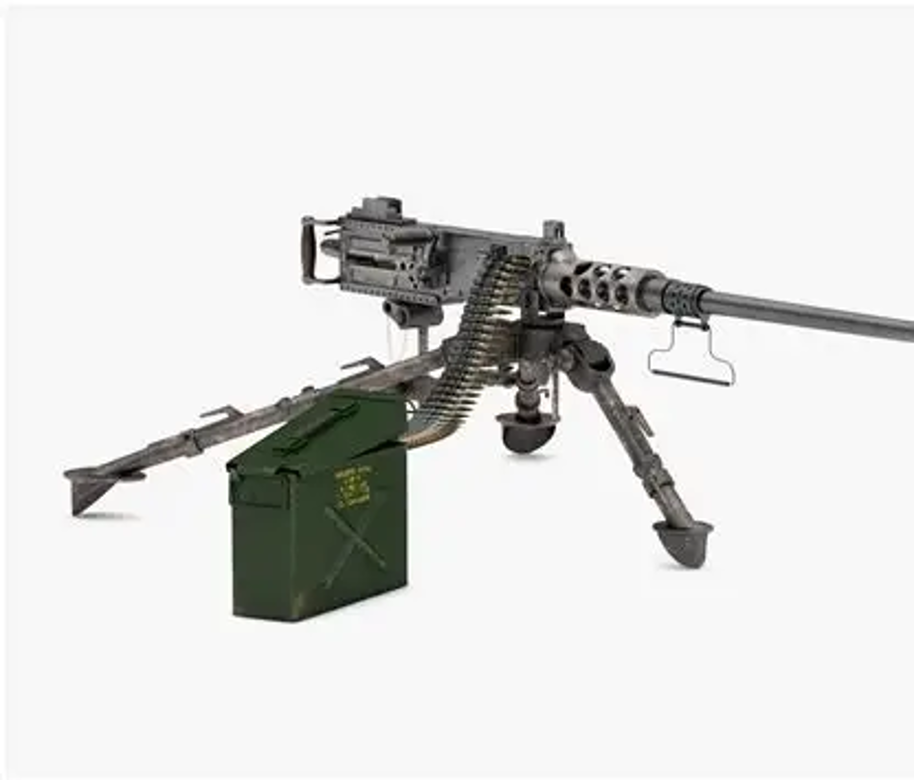
Audie Murphy had the best weapon possible for his situation. The .50 caliber M-2 has a throaty boom to it. The muzzle blast is exhilarating. The rounds it fires are five times heavier than an M-1 rifle bullet. It stands out against the other rifle caliber machine guns on the battlefield. Tank mounts or tripods absorb the recoil and balance the weapon. Shooting it feels effortless and instantly promotes the operator to bad ass status.
There are many privately owned M-2 guns around and quite legal with government paperwork. People will pay five to seven dollars a round for a test fire. If you ever get the chance to run a few rounds through an M-2 machine gun, first look to heaven and thank Audie Murphy, then brace yourself for some serious fun. Remember that the weapon is intended for anti-aircraft use. It was originally considered to be an anti-tank weapon. It fires all manner of explosive, incendiary, tracer and armor piercing rounds so one can only imagine what a .50 caliber does to a mere human being. Murphy had him some gun.
 Murphy faced a full company of German mountain troops and six tanks on the day he won the Medal of Honor. He was standing on the engine deck of an M-10 tank destroyer which had an open top turret so he could easily reach extra ammunition. (See picture which is correct to scale) Of course he did the real damage with a field telephone but while waiting for called artillery he worked over anyone that got close including an entire squad of soldiers at near point blank range. The M-2 .50 was the largest small arm in use at that time… other than grenade launchers I suppose, it might still be. He also used his M-1 carbine in that fight, which was the smallest caliber weapon then in use by Allied forces.
Just to put the weapon in a greater context, most American fighter planes from the P-40 Warhawk series right on through to the F-86 Sabre jet used a suite of two, four or eight fifty caliber guns to buzz saw enemy aircraft and blow-up trains. Chuck Yeager commented that the .50 caliber armor piercing incendiary rounds penetrated enemy aircraft and did damage deep inside where as explosive 20 m/m cannon rounds favored by the British, Germans, Japanese, and the Soviets tended to explode on contact with a fuselage where the damage was sometimes superficial. The fifty-caliber machinegun was ideal for taking down lightly built Japanese fighters like the Zero. There is also the question of load out. Fifty caliber ammunition is far lighter than cannon ammunition. American fighters carried from 250 to more than 400 rounds per gun depending on the aircraft. Early 20 m/m cannons were fed by drum magazines often holding as few as sixty rounds. Their rate of fire was low as was the muzzle velocity.
Cannons were prone to malfunction, especially those that fired through the propeller hub like the early model ME-109 fighters and the American Bell P-39 Airacobra. Of course, they also offer limited ammunition supply. Early cannon armed Spitfires could boast about five seconds of cannon firing time-- if the weapons cycled. If one gun of the pair went down, firing the other upset flight characteristics. No wonder their Spitfires also retained a quartet of their inadequate .30 caliber guns. So long as the M-2 fifty-caliber sat upright in the wing, it fed quite reliably. Canting the weapon to make it fit in a thinner wing caused problems. The Original Mustang P-51B long range escort had this issue and pilots reported constant gun jams while pulling high G maneuvers, but by the time the P-51D model became standard the weapon’s feeding issues were solved.
The Japanese mounted cannon/ rifle caliber weapons in their famous Zero A6M but their effectiveness has been criticized. The muzzle velocity was low, ammunition supply was limited and pilots said that they difficult to aim. Later in the war, The Japanese came with their own .50 caliber fighter aircraft armament based on the U.S weapon called the HO-103, but their round was not quite as powerful as the American original.
The only American fighters that carried cannons as standard armament during world War Two were the P-38 Lightning, the P-39 Airacobra (which mounted a 37 m/m cannon or a 20 m/m that fired through the propeller hub) and the P-61 Black Widow night fighter. The Helldiver dive bomber mounted a pair of 20 m/m guns that were much more useful against naval targets than a .50 caliber ever could be. The United States Navy switched to all cannon armament with the F6U Chance Vought Pirate and stuck with a four-gun suite through the F-8 Crusader whose four gun loved to jam in high G maneuvers. They called the F-8 the last of gun fighters. I can understand how missiles became the emphasis when the guns were all but useless. The F9F Panther mounted four 20 m/m guns. The Corsair fighter received cannon armament as well. The F-100 Super Sabre had four cannons but the introduction of the Vulcan rotary 20 m/m Gatling gun in the F-104 and F-105 proved to be a superior air-to-air weapon and is still in use today.
People love to argue about .50 versus 20 m/m. The real issue is a matter of what time in history frames the debate. The M-2 would have been pointless in the air during World War One except perhaps for zeppelin defense. If I had to choose which weapons I would want in my WW-2 fighter, M-2 Browning guns would be a no-brainer, but as jets came on line, the time on target needed to get enough hits to kill a MIG-15 might make me rethink that one. The F-86H Saber was one of the first jets to switch over from .50 to 20 m/m armament. The guns, however, were not as reliable as the .50. Headspace issues and light primer strikes were difficult problems to iron out.
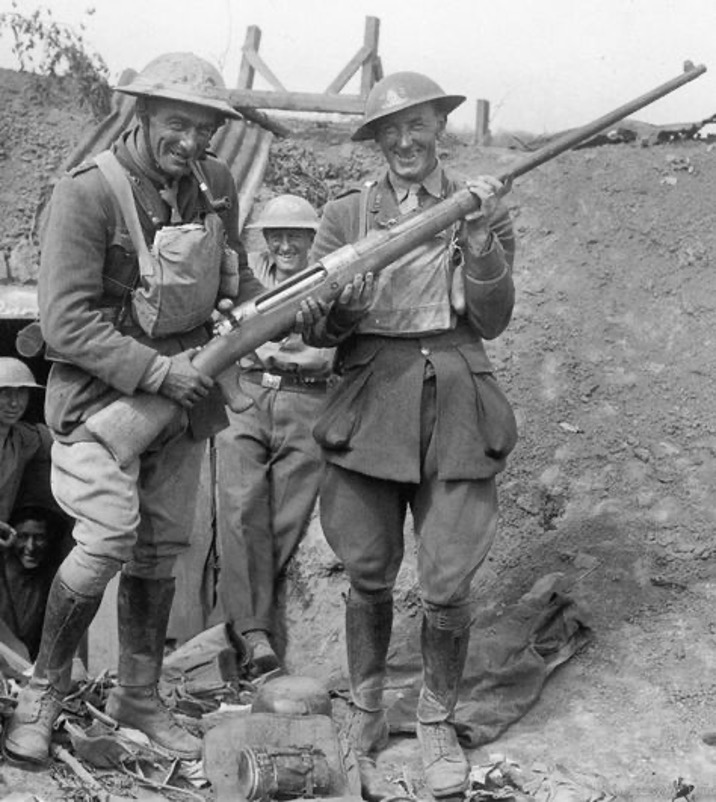
Certainly as a tanker’s secondary weapon, in the West, the M-2 is still peerless. The DShk holds this honor in the East. I am left to wonder what might have happened if the Germans had an effective .50 caliber weapon during the First World War. They could have mowed down every Allied tank like so many exposed infantry with such a weapon. Their bolt action antitank rifles were a step in the right direction.
The Browning designed M-2 machinegun is perhaps the most destructive infantry small-arm of all time. You can have one for the Low price of fifty grand plus the tax stamp of course. Like they say, “Get two, they’re small.”