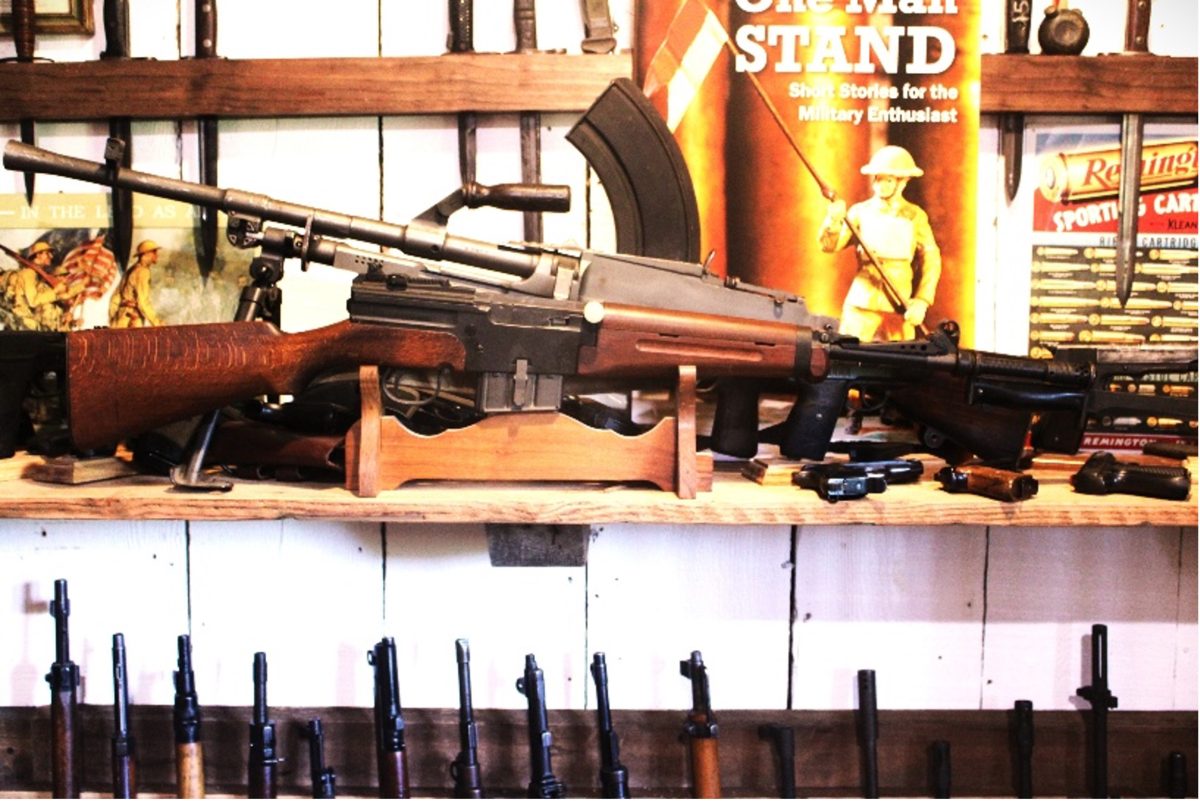

We should talk for a moment about small arms that might have been.
Hitler’s generals were appalled when he made his moves on France and the Low Countries. The Nazis made the invasion of Poland look easy. But, as it turned out, Operation Fall Weiss placed tremendous stress on the German’s military machine. In the High Command’s opinion, Germany wasn’t even close to ready for all-out war in Europe. They advised the Furer to play nice with everyone for five years as they built up their forces prior to opening hostilities. What if Hitler took their advice? Where would small-arms design have stood when that war did begin? I’ll tell you who the big winner might have been, and it is not the Nazis or the United States.
The general issue semiauto battle rifle was the post-World War One Holy Grail. As early as 1936, the M-1 Garand proved that this was quite possible. The Soviets attempted to keep pace with the Tokarev series. Absent war, would the Soviets have perfected the SVT-40 or come up with a new design? Would they have developed the SKS rifle? I suspect not. What if Stalin never went round and round with the Finns? Would the Soviets have developed their distinctive line of submachineguns?
The British, no doubt, would have stuck with their trusty SMLE bolt actions and Bren guns. They would have had no reason to develop the Sten. This raises the question of how far stamping and press fitting technology in the small-arms field would have developed absent imminent battle. Would the expense of the Thompson gun have priced it out of general issue in the British Army? There would be no impetus to create the Owen gun either.
Where would FN have stood had Belgium not been invaded with the rifle they eventually dubbed the FN-49? This would eventually become the FAL rifle. It was tested with intermediate power ammunition after the war but the adoption of the 7.62 NATO round transformed it into a battle rifle instead of a Belgian sturmgewehr. The FN factor cannot be dismissed.
The United States would have felt quite satisfied with the M-1 and the rest of her small arms, though they would be expensive. American weapons get all the best descriptors. The M-1 Garand was peerless. The Thompson was epic. The Colt 1911 was another equalizer. It is possible that the M-1 carbine’s promotion to assault rifle might have occurred absent a war. It just makes sense to shift over from heavy .45 caliber submachineguns to a lighter but longer ranged and more accurate cartridge. I am left to wonder if the rest of the world would have noticed this development without a war going on.
Before World War Two kicked off, the Soviets, Belgians, Germans, and the French were all working on semi-automatic rifles, but their creations were not yet up to the American Garand standard. Well, except for the French. I just made many of my readers gasp. The French MAS 1940 semi-auto rifle, in many ways, was a far superior weapon to the complex and expensive American M-1 rifle.
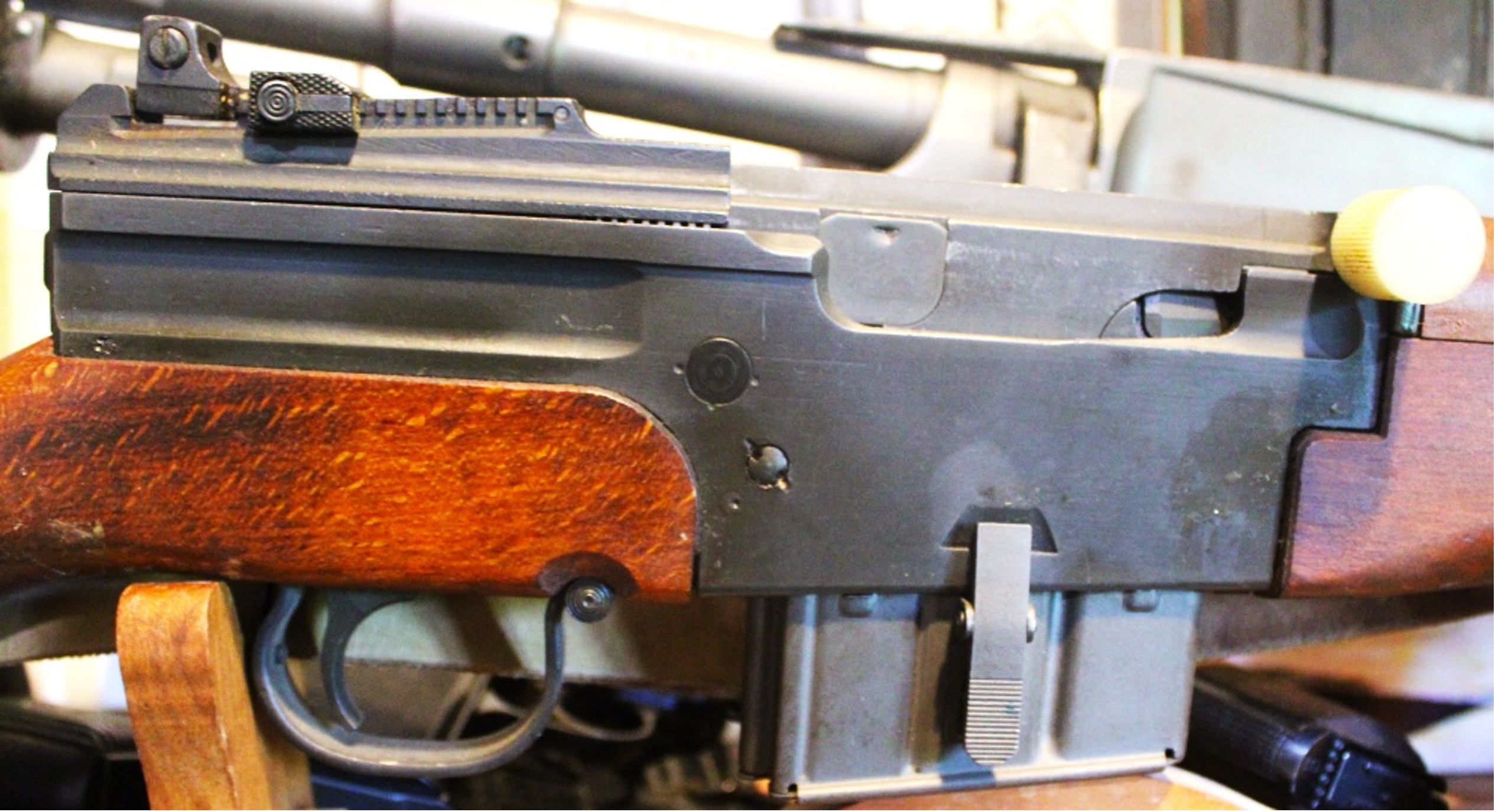
For starters, the MAS 1940 rifle just jumps apart. Training troops in its use and maintenance would be a snap. It is robust in the extreme, plus it is dirt cheap and blissfully easy to manufacture. It uses direct gas action so no gas piston is needed. The 1944 model featured a detachable and stripper clip loadable ten round magazine with an odd external latch. Unlike the M-1 Garand, it can be topped off. The MAS rifles were optimized for launching rifle grenades which were still in vogue at that time. The 1949 Model even accepted a useful telescopic sight. It was also a little lighter than the M-1. Yes, it looked a little… French, but mine runs like a champ with French military surplus ammunition.[1]
I don’t care where your troops are from, the MAS-44 design is virtually soldier proof. I cannot vouch for this, but I have read that the French rifle was more reliable than the Garand as well. Neither my Garand, nor the MAS 49/56 have ever malfunctioned on me. Everyone would have wanted a license to manufacture the MAS semi-auto. If the Second World War had been delayed, I think it possible that the French might have taken the lead in military service rifle design and where would we be if we had to give up sneering at French rifles? Remember what was written on the French service rifle’s sales tag: Never fired, dropped once.
The Germans scrutinized the French military complex, and they used French weaponry extensively wherever they could to free up German equipment for real action. They must have known about the MAS 1940. I have heard reports of French designers hiding its existence as well. Whatever the case, think of what it would have been like for American and British troops to face Germans armed with a ten or even twenty shot semiautomatic in addition to their devastating MG-42 machine guns. No doubt, the Germans would have changed the rifle’s aesthetic, you know, Nazied it up. As it was, I believe that Teutonic hubris over French weapons kept them adopting a war winning design.
The truth is that the French have been very influential in the firearms field. Most gun nuts do not appreciate that they fielded a semi-auto rifle, the RSC 1917 and 1918 in time for troop trials during the First World War. They get credit for smokeless powder and, like it or not, their Chauchat monstrosity actually did work. They should receive credit for other weapons too. They contributed significantly to aircraft design during the First World War and even developed what became the final layout of all modern tanks with driver in front, turret in the middle, and engine to the rear. They fought valiantly in the trenches. Their defeat in the Second World War is a testament to not keeping up with military doctrine. They put their faith in the massive Maginot Line instead of little things like better radios and tanks with two man turrets. On paper, the French defense in depth was reassuringly dense, but surprisingly, if you simply go around it, fortress guns and millions of tons of concrete pose surprisingly little hazard.
So, in this Second World War begins in 1945 scenario, the Germans are hard at work secretly preparing for a high tech blitzkrieg. They knew that their initial panzer tanks were inadequate, but many of their best innovations were the direct result of extended combat with the Soviets. It is impossible to know what their tanks and other weapons might have looked like with five more years to mature, or how far their aircraft might have advanced absent a hot war. What if the Nazis never copied the Tokarev gas system to produce their G-43 rifle? They might have been side tracked by poor semi-automatic designs like the G-41.
The big questions remain. Would Schmeisser have come up with the StG-44? They were working on the intermediate cartridge well before 1939. It took the imperatives of the Russian Front to make the need for an assault rifle clear to everyone else, but Schmeisser correctly gauged the battlefield situation. If the Nazis knocked over the Soviets first in the 1945 scenario, they might do so very quickly and the need for a weapon to even the odds might not have been felt. Nothing about the conflict between designers and high command would have changed. German engineers were enlightened. They knew that long range accuracy was over rated, but I suspect that the conservative German general staff would not have seen it the same way because they had stockpiled literally a billion rounds of 7.9 m/m. You don’t just write an asset like that off. The United States might have adopted the .276 Pedersen had it not been for the fact that we had a bazillion rounds of .30 M-1 ammunition stockpiled. Indeed, investing in ammunition seems to be an unappreciated road block in small-arms design.
I think it likely that the first true assault rifles might not have made the scene until the late 1940s. Once war broke out in 1945, I doubt it would take the Germans and Soviets long to discover that their new breed of semiautomatic battle rifles were not reliable enough for general issue. This might have prompted assault rifle development, but it would have taken considerable time to field a prototype. Losing the upper hand might also have pushed the Nazis into an assault rifle frame of mind. Their civilian army, known as the Volkssturm, needed weapons that required virtually no training. Old men, children and women would wield crudely made VG-1 and VG-2 assault rifles in desperate last ditch fury. It seems possible that some version of these crude weapons could have been the genesis of the sturmgewehr.
An often unappreciated characteristic of assault rifles relates to how easy it is to train people in their effective use. Every school child in Russia learns how to assemble and maintain an AK-47. Smaller statured troops had a rifle that they could accurately fire. Anyone can shoot an M-1 carbine or AR-15. Seriously, I’m not saying Stephen Hawking could do it, but certainly Betty White could throw down with one. For that reason alone, the world’s larger armies would have eventually turned to the assault rifle, and absent the MP-44 as a starting point, we can only imagine what they might have devised.
And what of an American assault rifle round based on the .30-06 chopped down to forty millimeters? Or would the American military go back to the .276? The Browning Automatic Rifle might have been scaled down. One wonders if the era of the battle rifle would have unfolded in a later World War Two, but it is impossible to know. I think we can be certain, however, that prolific and inexpensive French rifles would have influenced the infantry fight.
[1] Commercial grade 7.5 French ammunition should not be used in semiautomatic MAS rifles as the use of soft primers can lead to slam fires. A special firing pin is available for use with this ammunition.